

The Weekly Dispatch
By Decotechs · Published weekly
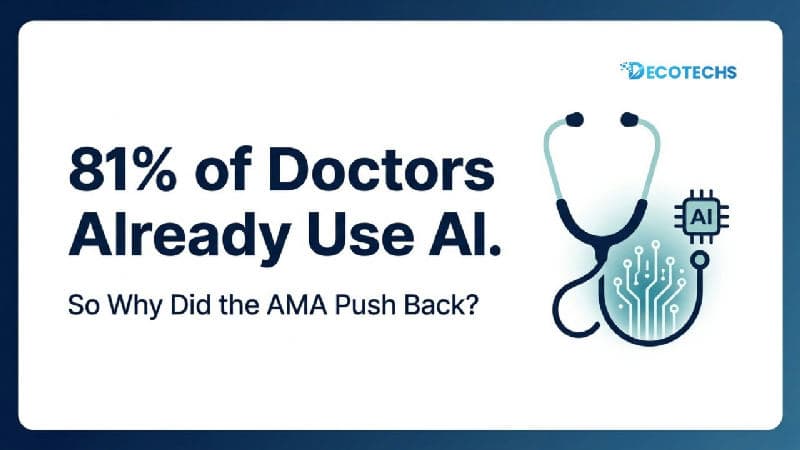
81% of Doctors Already Use AI. So Why Did the AMA Just Push Back on HHS?
Decotechs
October 12, 2026
How the US healthcare AI debate is shaping what businesses should build next
Meta description: US physicians are adopting AI fast, yet the AMA just challenged claims that AI is better than doctors. Here’s what the debate means for anyone building AI agents and automation.
Healthcare AI had a loud week in the United States, and the numbers behind it are worth a closer look.
According to the AMA’s 2026 physician survey, 81% of physicians now use AI in their practices, more than double the 38% reported in 2023. The most common uses are summarizing medical research and clinical documentation. healthcarefinancenews
So adoption is not the problem. Then why did six major physician organizations, including the AMA, publicly respond to Health Secretary Robert F. Kennedy Jr.?
The statement that sparked the pushback
Kennedy had argued that doctors have only minutes with each patient and that AI can distill the record for them. The medical societies replied that suggesting AI is inherently better informed than physicians diminishes physician expertise and risks undermining patients’ trust. They added that pitting physicians against technology does not advance the work. fiercehealthcare
The timing matters. In August, a JAMA perspective argued that AI-alone medical care is likely to be better than physician-only or physician-AI hybrid care. The question has moved from “should we use AI?” to “who is in charge when we do?” fiercehealthcare
The tension is not only between doctors and officials. AP reported that some MAHA voices also criticized the move, while experts like Harvard’s Glenn Cohen warned of a “techno-utopian” view that overlooks how market incentives can diverge from the public good. click2houston
The same week: a $942 million argument over AI billing
Another story shows why governance matters. Blue Cross Blue Shield Association research estimates that AI-assisted clinical coding added $942 million in hospital costs between 2024 and 2025 compared with 2023. pasqualepillitteri
Hospitals disagree. The AHA says the analysis does not review the underlying medical records or identify which claims involved AI tools. Other coverage notes the study did not establish a direct causal link between specific AI systems and the outcome. chiefhealthcareexecutiveforklog
Both sides use automation. Hospitals use AI for documentation and coding, insurers use it to review claims. Nobody can easily audit what the AI actually did.
The real lesson: adoption is outrunning governance
A new Healthcare AI Readiness Index from Cotiviti and MedCity News found that healthcare organizations are adopting AI faster than they’re building the governance and cybersecurity frameworks needed to use it safely. openloophealth
That is the pattern behind both stories. When an AI tool’s decisions can’t be traced, reviewed or explained, even a good tool becomes a source of conflict.
Healthcare is the sharpest example, but the lesson applies to any industry putting AI into real workflows.
What this means for businesses building AI agents
Whether you run a hospital group, a clinic network, a retailer or a services company, the US debate points to a few practical principles:
- Keep a human in the loop for high-stakes decisions. Let AI draft, summarize and flag. Let people approve. This is the position the physician groups are defending, and it is good design in any field.
- Make every AI action traceable. Log what the agent did, what data it used and why. If you can’t audit it, you can’t defend it.
- Start with low-risk, high-volume work. Appointment booking, reminders, follow-ups, report generation and CRM updates are where AI saves hours with limited downside. A real example from this week: Mass General Brigham’s AI intake agent in MyChart connects 77% of patients with a physician the same day. openloophealth
- Connect AI to the tools your team already uses. An agent that lives inside your existing systems gets used. A standalone tool often doesn’t.
- Set governance rules before you scale, not after something goes wrong.
Where Decotechs fits
At Decotechs, we help businesses build AI agents that automate communication, operations and research, from n8n workflow agents and chatbots to voice assistants for appointment booking and multi-agent systems, connected to tools like Slack, Gmail, Notion and CRMs.
The US healthcare debate reinforces how we approach this work: automate the repetitive tasks, keep people in control of the decisions that matter, and build systems you can explain.
Thinking about what AI agents could take off your team’s plate? Share the task or pain point, and we’ll help you plan a prototype.
Talk to us at decotechs.com


The Weekly Dispatch
Decotechs' weekly newsletter on AI agents, automation, and software engineering insights.
